How far do you think cooperation, competition and confrontation have shaped the nature of federation in India? Cite some recent examples to validate your answer. (UPSC 2020)
Indian federalism is not fixed; it is shaped by a constant mix of cooperation, competition and confrontation. The balance among them has made India a quasi-federal but workable union, where states are partners, rivals and critics at once.
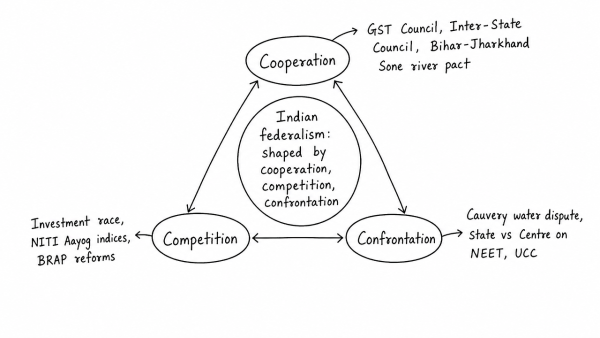
- Cooperation: The GST Council forces Centre and states to negotiate rates and revenue sharing. The revived Inter-State Council and recent agreements on water sharing, including the Bihar-Jharkhand Sone river pact, show shared problem-solving.
- Competition: States now compete for investment, jobs and better rankings. NITI Aayog indices, BRAP reforms, and the race among states for major factories and data centres have encouraged policy innovation and faster delivery.
- Confrontation: Tensions remain over Governors delaying bills, borrowing limits, cesses and surcharges, and disputes on delimitation. The Supreme Court’s intervention in the Tamil Nadu Governor case underlined these frictions.
Thus, cooperation gives stability, competition adds dynamism, and confrontation checks overreach. Together, they have made Indian federation flexible, conflict-prone, but resilient.
Originally written on
September 2, 2026
and last modified on
September 2, 2026.