How far do you agree with the view that tribunals curtail the jurisdiction of ordinary courts? In view of the above, discuss the constitutional validity and competency of the tribunals in India. (UPSC 2018)
Tribunals do curtail the jurisdiction of ordinary courts, but only to a limited extent. They were created to provide speedier, specialised justice in selected fields such as service, taxation, company law and the environment. Yet, in India, they cannot wholly replace the constitutional role of ordinary courts.
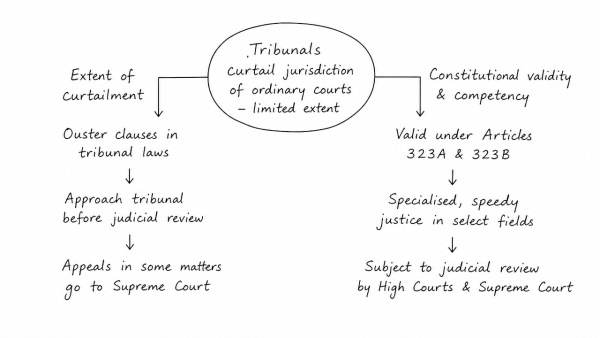
- Extent of curtailment
- Many tribunal laws contain ouster clauses, reducing the role of civil courts in the first instance.
- Litigants are often required to approach the tribunal before any higher judicial review.
- In some matters, appeals are channelled directly to the Supreme Court, bypassing High Courts.
- Limits imposed by the Constitution
- In L. Chandra Kumar, the Supreme Court held that the power of judicial review under Articles 226/227 and 32 is part of the basic structure.
- Therefore, tribunal decisions remain subject to scrutiny by the jurisdictional High Court.
- Tribal systems are thus supplementary, not substitutes for constitutional courts.
- Constitutional validity
- Articles 323A and 323B, inserted by the 42nd Amendment, provide the constitutional basis for tribunals.
- Parliament and State legislatures are competent to create them under the relevant legislative entries.
- Their validity depends on fair procedure, independence, and preservation of judicial review.
- Competency of tribunals
- They offer specialised knowledge, flexible procedure and faster disposal.
- However, vacancy, inadequate infrastructure and executive control over appointments weaken their effectiveness.
- Such defects harm public confidence and dilute their constitutional promise.
Thus, tribunals do curtail ordinary courts in specific subject areas, but not to the extent of excluding constitutional supervision. Their legitimacy lies in combining specialisation with independence, while ordinary courts remain the final guardians of justice and rights.
Originally written on
September 1, 2026
and last modified on
September 1, 2026.