How far do you agree with the view that the focus on lack of availability of food as the main cause of hunger takes the attention away from ineffective human development policies in India? (UPSC 2018)
There is considerable merit in the view. Hunger in India is not only a problem of food supply; it is equally a problem of poor nutrition, weak health systems and unequal access to human development services. India has achieved record foodgrain output, yet serious hunger and child malnutrition persist.
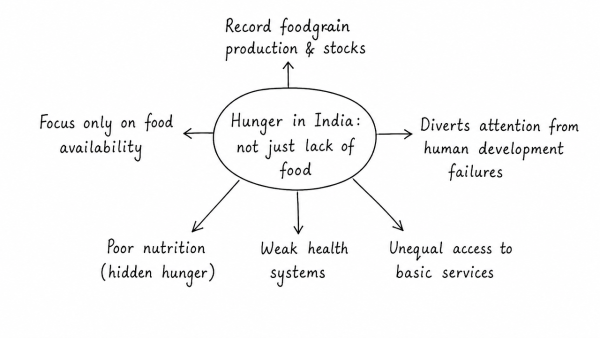
- Food availability is not the only issue: Even with high production and large public stocks, many people cannot afford a healthy diet. The PDS remains cereal-heavy, which helps in avoiding starvation but not hidden hunger caused by lack of proteins, fats and micronutrients.
- Human development gaps deepen hunger: Unsafe drinking water, poor sanitation and repeated infections reduce nutrient absorption. Child undernutrition is also shaped by maternal anaemia, early marriage, low female education and weak maternal care.
- Hunger is multi-dimensional: It reflects poverty, low purchasing power, poor access to health services, and low awareness. Hence, food may be present in markets, but poor households still remain hungry or undernourished.
- Policy focus needs correction: Article 47 calls for improved nutrition and public health, not merely food distribution. Schemes such as NFSA and PM-GKAY must be linked with nutrition, sanitation, health and women’s empowerment.
| What is needed | Why it matters |
| Diet diversification | Reduces micronutrient deficiency |
| Clean water and sanitation | Improves nutrient absorption |
| Maternal and child health | Breaks the intergenerational cycle |
| Female education and agency | Improves child feeding and care |
Thus, I largely agree that focusing only on food availability diverts attention from deeper causes of hunger. A shift from food security to nutritional security, backed by stronger human development policies, is essential for lasting reduction in hunger in India.
Originally written on
September 1, 2026
and last modified on
September 1, 2026.