How does the Juno Mission of NASA help to understand the origin and evolution of the Earth? (UPSC 2017)
NASA’s Juno mission studies Jupiter, the first giant planet to form, and thus preserves clues to the solar nebula from which Earth arose.
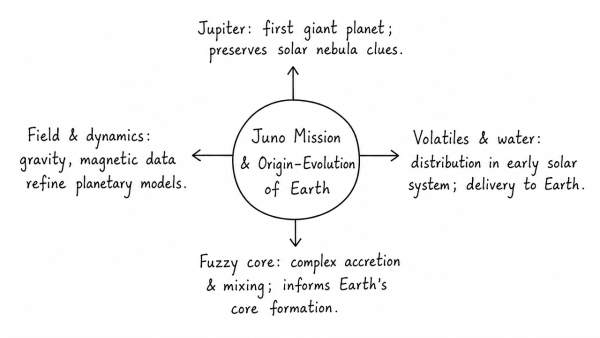
- Volatiles and water: Juno’s measurements of Jupiter’s atmospheric water and composition help infer how water and other volatile materials were distributed in the early solar system and later delivered to Earth.
- Planet formation: The discovery of a “fuzzy” core suggests planets grow through complex accretion and mixing, improving models of Earth’s internal differentiation and core formation.
- Field and dynamics: Juno’s gravity and magnetic data refine understanding of planetary dynamos and the internal evolution of giant planets, allowing comparison with Earth’s geomagnetic system.
- Solar system history: Jupiter’s gravity shaped asteroid movement, the asteroid belt and early bombardment, influencing Earth’s growth and habitability.
Thus, Juno helps reconstruct the early solar system and the processes that led to Earth’s origin and evolution.
Originally written on
August 31, 2026
and last modified on
August 31, 2026.