How does the cryosphere affect global climate? (UPSC 2017)
The cryosphere, comprising snow, glaciers, sea ice, ice sheets and permafrost, is a major regulator of Earth’s climate. It affects temperature, ocean circulation and atmospheric patterns, while also storing vast amounts of freshwater and carbon.
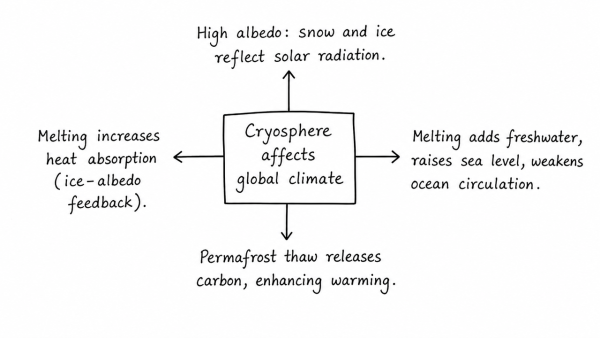
- High albedo: Snow and ice reflect much solar radiation. When they melt, darker land and ocean absorb more heat, increasing warming through ice-albedo feedback.
- Sea-level and ocean effects: Melting glaciers and ice sheets raise sea level. Freshwater input from Greenland and Antarctica can weaken dense-water formation, slowing key ocean currents and altering regional climate.
- Carbon feedback: Permafrost stores frozen organic carbon. Thawing releases carbon dioxide and methane, strengthening the greenhouse effect.
- Weather patterns: Arctic warming reduces the pole-equator temperature gap, which can disturb the jet stream and lead to persistent heatwaves, cold spells and erratic rainfall.
Thus, the cryosphere is both a climate regulator and a sensitive indicator of warming. Its rapid decline can trigger self-reinforcing changes with global consequences.
Originally written on
August 31, 2026
and last modified on
August 31, 2026.