How does biodiversity vary in India? How is the Biological Diversity Act, 2002 helpful in conservation of flora and fauna? (UPSC 2018)
India’s biodiversity is highly uneven because of its large size, varied climate, altitude, rainfall, soils and coastline. Though India occupies about 2.4% of the world’s land area, it supports nearly 7–8% of recorded species and includes cold deserts, alpine meadows, tropical rainforests, mangroves and coral reefs.
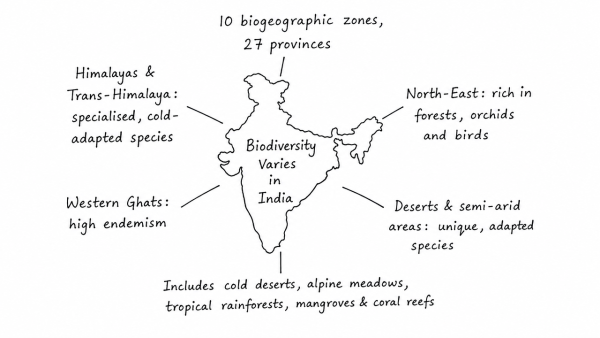
- Spatial variation: India has 10 biogeographic zones and 27 provinces, giving distinct ecological conditions.
- Regional patterns: The Himalayas and Trans-Himalaya have specialised, cold-adapted species; the Western Ghats show high endemism; the North-East is rich in forests, orchids and birds; deserts and semi-arid areas support drought-resistant flora and fauna; islands and coasts contain mangroves, reefs and marine life.
- Hotspots: Parts of the Himalayas, Western Ghats, Indo-Burma and Sundaland fall within global biodiversity hotspots.
The Biological Diversity Act, 2002 strengthens conservation through a three-tier system of the National Biodiversity Authority, State Biodiversity Boards and Biodiversity Management Committees, which regulate use and protect local biodiversity.
- Documentation: People’s Biodiversity Registers record species and traditional knowledge.
- Benefit sharing: It ensures fair sharing of gains from use of biological resources, discouraging biopiracy and over-exploitation.
- Local protection: BMCs and Biodiversity Heritage Sites promote sustainable use and conserve fragile habitats.
- Regulation: Prior approval for access and commercial use helps monitor extraction and safeguard flora and fauna.
Thus, India’s biodiversity is regionally diverse and the Act helps conserve it by combining regulation, documentation, community participation and fair benefit sharing.
Originally written on
September 1, 2026
and last modified on
September 1, 2026.