
How do you explain the statistics that show that the sex ratio in Tribes in India is more favourable to women than the sex ratio among Scheduled Castes? (UPSC 2015)
The sex ratio among Scheduled Tribes is generally more favourable to women because many tribal societies are less patriarchal than caste-based society. Census 2011 showed 990 females per 1,000 males among STs, against 945 among SCs.
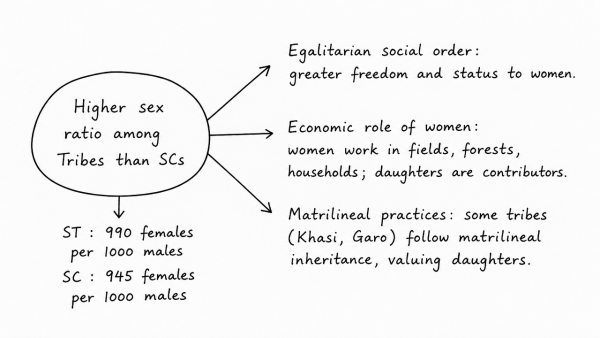
- Egalitarian social order: Tribal kinship is often more flexible, with greater freedom and status for women.
- Economic role of women: In many tribal economies, women work in fields, forests and households, so daughters are seen as contributors rather than burdens.
- Matrilineal practices: Some tribes, such as the Khasi and Garo, follow matrilineal inheritance, which raises the value of girls.
- Marriage customs: Bride price in several tribal groups contrasts with dowry in many SC communities, reducing son preference.
- Isolation from sex selection: Remote tribal areas have had less access to prenatal sex selection technologies.
By contrast, many SC groups live closer to mainstream caste society, where patriarchal norms, dowry and son preference are stronger. However, this advantage is weakening as tribal communities become more integrated and adopt similar social practices.
Originally written on
August 29, 2026
and last modified on
August 29, 2026.
