How do the melting of the Arctic ice and glaciers of the Antarctic differently affect the weather patterns and human activities on the Earth? Explain. (UPSC 2021)
The Arctic and Antarctica differ physically: the Arctic is a frozen ocean surrounded by land, while Antarctica is a continent covered by thick land ice. Hence, their melt affects Earth differently.
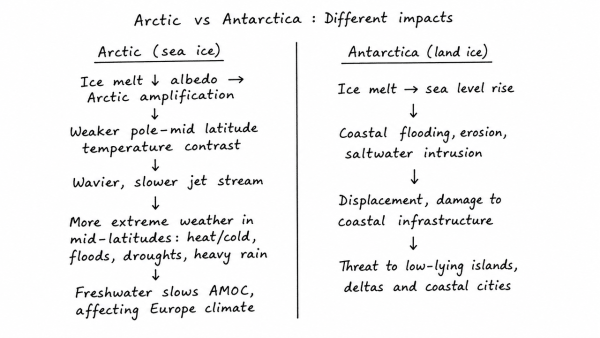
- Arctic ice melt: Loss of sea ice lowers albedo, causing stronger warming known as Arctic amplification. This weakens the pole-to-mid-latitude temperature contrast, making the jet stream wavier and slower. The result can be persistent heat waves, cold spells, floods, droughts and heavy rainfall in the mid-latitudes. Freshwater from Greenland can also slow the Atlantic Meridional Overturning Circulation, influencing European climate and monsoon patterns.
- Human impact in the Arctic: Melting opens shorter shipping routes, boosts access to oil, gas and minerals, but also damages infrastructure through permafrost thaw and coastal erosion.
- Antarctic glacier melt: Melting of land ice and ice shelves adds freshwater to the Southern Ocean, affecting deep-water formation, ocean circulation and Southern Hemisphere wind belts. This can shift storm tracks and rainfall in South America, southern Africa and Australia. Its most serious global effect is sea-level rise.
Thus, Arctic melt mainly alters atmospheric circulation and northern economic activity, whereas Antarctic melt chiefly raises sea level and reshapes Southern Ocean-driven weather patterns.
Originally written on
September 2, 2026
and last modified on
September 2, 2026.