How can the mountain ecosystem be restored from the negative impact of development initiatives and tourism? (UPSC 2019)
Mountain ecosystems are highly fragile, but development pressure, road building and mass tourism have increased slope instability, water stress, waste and biodiversity loss. Restoration must combine strict regulation, scientific planning and community participation so that growth does not exceed ecological limits.
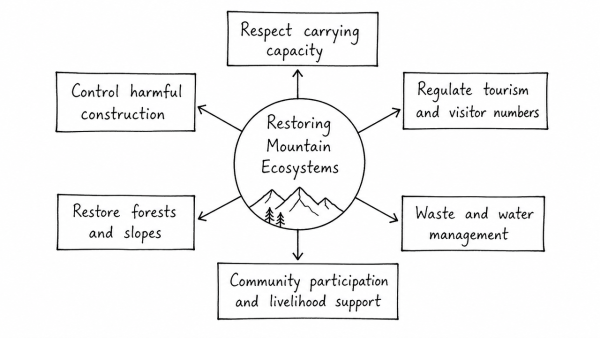
- Respect carrying capacity: Prepare scientific carrying-capacity studies for every major hill destination and align land use, roads and town plans with slope stability, seismic risk and water availability.
- Control harmful construction: Limit large concrete structures in fragile zones, avoid building on unstable slopes, and use lightweight, hazard-resistant materials with proper drainage, retaining walls and bio-engineering.
- Reform tourism: Shift from mass tourism to regulated, low-impact tourism through permits, green cess, waste fees and promotion of homestays over hotel clusters.
- Restore water systems: Rejuvenate springs, protect catchments, and conserve alpine wetlands and forests that recharge groundwater and reduce landslide risk.
- Protect biodiversity: Recover degraded habitats, control invasive species, and avoid tree plantation on natural grasslands and alpine meadows. Native species should be used for restoration.
- Use monitoring and early warning: Apply remote sensing, hazard mapping and real-time alerts for landslides, GLOFs and land subsidence.
- Empower local communities: Involve local people in eco-tourism, waste management and monitoring, and provide incentives for sustainable livelihoods.
The constitutional duty to protect the environment, along with missions on Himalayan ecology and biodiversity, provides a strong policy base. Lasting restoration in mountain regions needs development that is slow, local and ecologically sound.
Originally written on
September 1, 2026
and last modified on
September 1, 2026.