How can building indigenous foundational AI models like BharatGen secure India’s technological sovereignty? Discuss in the light of growing reliance on foreign proprietary AI systems.
Building indigenous foundational AI models such as BharatGen can strengthen India’s technological sovereignty by placing the control of data, models and infrastructure within national reach. In a world where foreign proprietary systems can be restricted, priced arbitrarily, or shaped by external strategic interests, sovereign AI becomes a matter of autonomy as much as innovation.
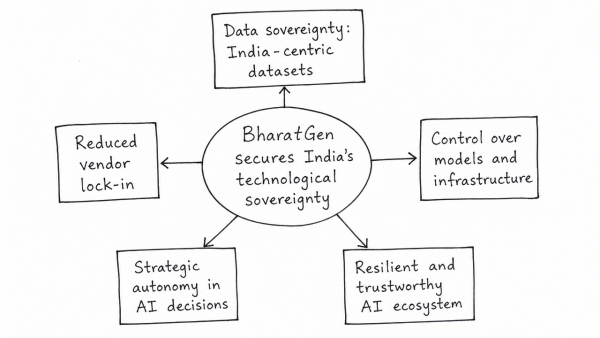
- Data sovereignty: BharatGen is designed around India-centric datasets through Bharat Data Sagar. This keeps sensitive Indian data, including text, speech and images, closer to domestic legal and ethical oversight.
- Reduced vendor lock-in: Indigenous foundational models lower dependence on foreign platforms whose access, pricing or terms may change due to geopolitical or commercial pressures.
- National security: Local control over AI helps protect critical infrastructure, defence applications and cyber systems from foreign surveillance, backdoors or external disruption.
- Linguistic and cultural fit: Support for 22+ Indian languages and dialects makes AI usable for a diverse population, unlike many foreign models that may miss local context or generate biased outputs.
- Economic value capture: A domestic base model allows Indian startups, researchers and ministries to build sectoral solutions such as Ayur Param, Agri Param and Legal Param, keeping value creation inside the country.
- Policy control: India can embed its own norms on privacy, fairness, accountability and safety rather than depending on foreign standards alone.
Growing reliance on proprietary foreign AI systems can deepen asymmetry in an era where access to frontier models may be curtailed overnight. BharatGen therefore supports “Digital Swadeshi” by building strategic capability, even if India continues selective global collaboration.
Originally written on
September 13, 2026
and last modified on
September 13, 2026.