How can biotechnology help to improve the living standards of farmers? (UPSC 2019)
Biotechnology can improve farmers’ living standards by raising productivity, reducing costs and creating new income sources. It helps farmers grow more with less land, water and input, while also making agriculture more resilient to climate shocks.
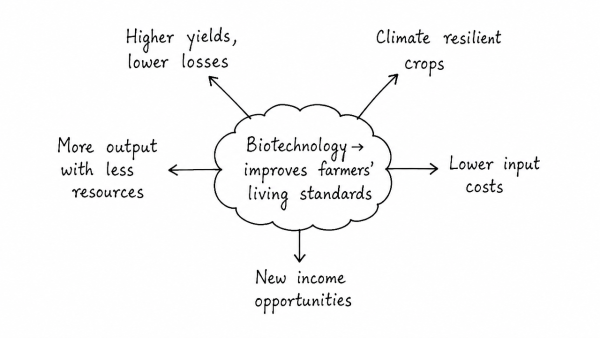
- Higher yields and lower losses: Improved seeds, biofertilisers and biopesticides can increase crop output and reduce damage from pests and diseases.
- Climate resilience: Gene-edited and stress-tolerant crops can better withstand drought, heat, salinity and flooding, reducing the risk of crop failure.
- Lower input costs: Bio-inputs such as microbial bio-stimulants and nano-fertilisers improve nutrient use efficiency, cutting dependence on costly chemical fertilisers.
- Better soil health: Microbial solutions and crop residue decomposers improve soil organic matter and fertility, supporting sustainable farming over the long term.
- Higher income through value addition: Biofortified crops like iron-rich rice, zinc maize and protein-rich wheat can fetch premium prices in niche markets.
- Livestock support: Animal biotechnology, including better breeds, sex-sorted semen and vaccines, reduces disease loss and improves milk and meat productivity.
- Local innovation and extension: Schemes linking scientists with small and women farmers help transfer region-specific technologies faster to the field.
| Impact | Result for farmers |
| More resilient crops | Stable harvests and reduced income volatility |
| Bio-inputs | Lower costs and healthier soils |
| Biofortified produce | Better nutrition and higher market value |
Thus, biotechnology can raise farm incomes, improve nutrition, reduce risks and support diversified rural livelihoods. Its real benefit depends on affordable access, safe regulation, local adaptation and strong extension services.
Originally written on
September 1, 2026
and last modified on
September 1, 2026.