How are the principles followed by the NITI Aayog different from those followed by the erstwhile Planning Commission in India? (UPSC 2018)
India’s development architecture changed fundamentally when the NITI Aayog replaced the Planning Commission. The former was designed for command-style planning and fund distribution, while the latter works as a strategic and advisory institution in a more federal, flexible and evidence-based manner.
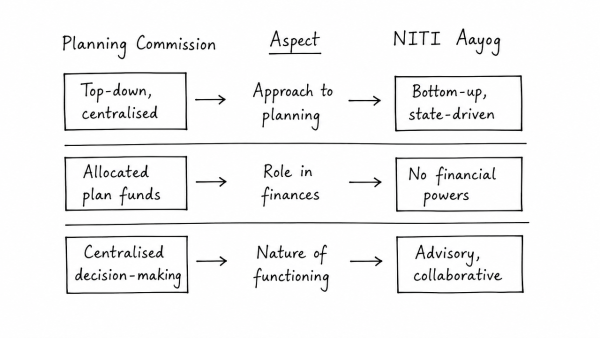
- Approach to planning: The Planning Commission followed a top-down, centralised model. NITI Aayog promotes a bottom-up approach, allowing States to frame priorities according to local needs.
- Role in finances: The Planning Commission had power to allocate plan funds to States and ministries. NITI Aayog has no financial powers; fund allocation is done by the Ministry of Finance.
- Federal spirit: The earlier body often made States passive recipients of Central decisions. NITI Aayog seeks cooperative federalism through the Governing Council and competitive federalism through rankings and reform incentives.
- Nature of institution: The Planning Commission was mainly a bureaucratic planning body. NITI Aayog functions as a policy think tank with domain experts, research support and technical advice.
- Planning style: The Planning Commission relied on rigid Five-Year Plans. NITI Aayog prefers long-term vision, medium-term strategy and short-term action plans, making planning more flexible.
- Method of governance: The Planning Commission reflected a socialist, state-led model. NITI Aayog accepts market forces, private sector participation, innovation and public-private partnerships.
- Monitoring: NITI Aayog places greater stress on evidence-based policy, data analysis and real-time monitoring of outcomes.
Thus, the Planning Commission was a centralised allocator and planner, whereas NITI Aayog is an enabling, consultative and reform-oriented institution aimed at stronger Centre-State partnership and better policy outcomes.
Originally written on
September 1, 2026
and last modified on
September 1, 2026.