How and to what extent would micro-irrigation help in solving India’s water crisis? (UPSC 2021)
Micro-irrigation—mainly drip and sprinkler—can significantly reduce India’s water stress by delivering water directly to the root zone, cutting evaporation, runoff and deep percolation losses, and improving farm water-use efficiency.
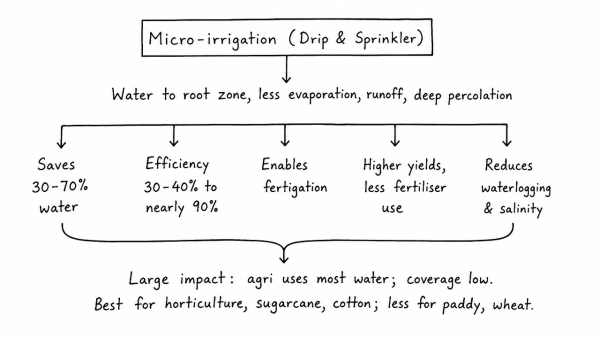
- How it helps: It can save 30–70% water, raise efficiency from about 30–40% to nearly 90%, enable fertigation, improve yields, and reduce fertiliser use, waterlogging and salinity.
- Extent: Its impact is large because agriculture consumes most freshwater and groundwater in India, but coverage remains limited. It works best in horticulture, sugarcane and cotton, and is less suitable for paddy and wheat.
- Constraints: High initial cost, small holdings, subsidy delays, weak pricing incentives and regional imbalance restrict adoption.
Thus, micro-irrigation is not a standalone fix, but a vital demand-side strategy when combined with crop diversification, groundwater regulation and watershed management.
Originally written on
September 3, 2026
and last modified on
September 3, 2026.