Highlight the Central Asian and Greco-Bactrian elements in Gandhara art. (UPSC 2019)
Gandhara art grew in north-west India at the meeting point of Indian, Central Asian and Greco-Bactrian cultures. It gave Buddhist art a new visual language, especially under Indo-Greek and Kushan patronage.
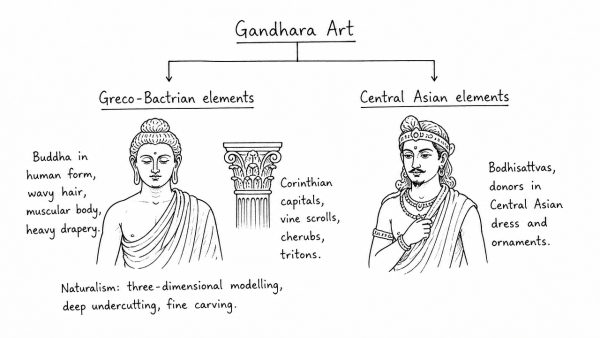
- Greco-Bactrian features: The Buddha is shown in human form with idealised facial proportions, wavy hair, muscular body and heavy, realistic drapery like the Greek himation.
- Classical motifs: Corinthian capitals, vine scrolls, cherubs, tritons and other Hellenistic motifs appear in architecture and decoration.
- Naturalism: Three-dimensional modelling, deep undercutting and fine carving reflect Greek sculptural influence.
- Central Asian features: Bodhisattvas, donors and rulers wear tunics, trousers, boots and pointed caps typical of steppe peoples.
- Symbolism: The halo, animal motifs and some ornamental patterns show West and Central Asian links.
Thus, Gandhara art is a striking example of cultural fusion, where Buddhist themes were expressed through Greco-Bactrian naturalism and Central Asian dress, symbols and artistic taste.
Originally written on
September 1, 2026
and last modified on
September 1, 2026.