Has digital illiteracy, particularly in rural areas, coupled with lack of Information and Communication Technology (ICT) accessibility hindered socio-economic development? Examine with justification. (UPSC 2021)
Yes. In rural India, digital illiteracy and poor ICT access have hindered socio-economic development by limiting access to education, livelihoods, welfare and governance. The issue is not mere device ownership but meaningful access, skills and reliable connectivity.
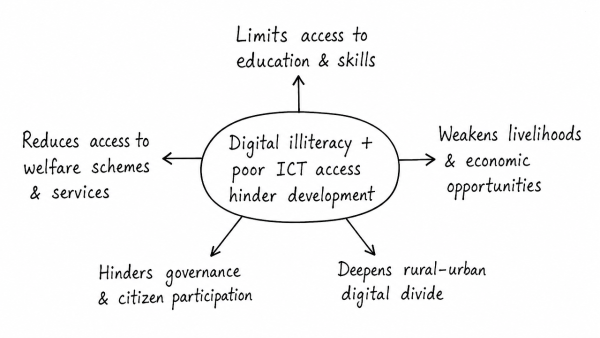
- Digital exclusion: A large share of the population remains offline, with rural areas facing sharper gaps in broadband, smartphones and basic digital skills.
- Education and skills: Online learning, e-content and digital skilling cannot reach the deprived effectively; weak ICT infrastructure in government schools reduces human capital formation.
- Livelihoods: Farmers, small enterprises and the self-employed need digital platforms for weather, prices, banking, credit and e-commerce; low access reduces productivity and market reach.
- Welfare delivery: DBT, Aadhaar-enabled services, pensions and banking increasingly use digital systems, but digital illiteracy forces dependence on intermediaries, causing delays, exclusion and exploitation.
- Social inequality: Women, the elderly and poorer households are more likely to remain excluded, widening gender and income gaps.
Thus, ICT exclusion does not merely reflect underdevelopment; it actively reproduces it, so last-mile connectivity, affordable devices, local-language platforms, and assisted digital literacy are essential.
Originally written on
September 2, 2026
and last modified on
September 2, 2026.