
Growing feeling of regionalism is an important factor in the generation of demand for a separate state. Discuss. (UPSC 2013)
Regionalism is attachment to a region on the basis of language, culture, ethnicity or shared history. It becomes politically significant when people believe their identity and interests are ignored within a large state.
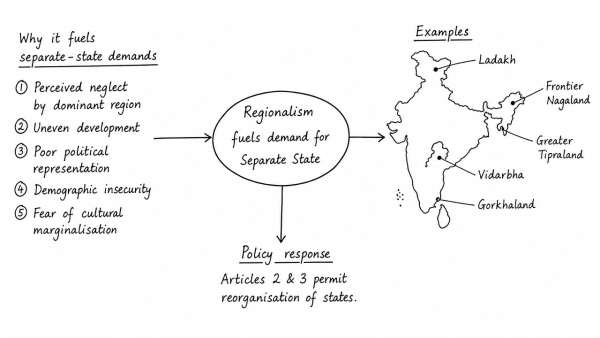
- Why it fuels separate-state demands: Perceived neglect by the dominant region, uneven development, poor political representation, demographic insecurity and fear of cultural marginalisation create demands for self-rule.
- Examples: Gorkhaland reflects cultural distinctiveness; Vidarbha, economic neglect; Greater Tipraland, tribal identity concerns; Ladakh and Frontier Nagaland, representation and backwardness.
- Policy response: Articles 2 and 3 permit reorganisation of states, while Articles 244 and 371 provide special provisions to address local needs.
Thus, growing regionalism is a major factor behind separate-state demands, though balanced development, decentralisation and responsive federalism can convert it from a divisive force into an integrative one.
Originally written on
August 28, 2026
and last modified on
September 6, 2026.
