Given the diversities among the tribal communities in India, in which specific contexts should they be considered as a single category? (UPSC 2022)
India’s tribal communities are culturally, linguistically and geographically diverse. Yet they should be treated as a single category where common constitutional protection, planning and justice are needed.
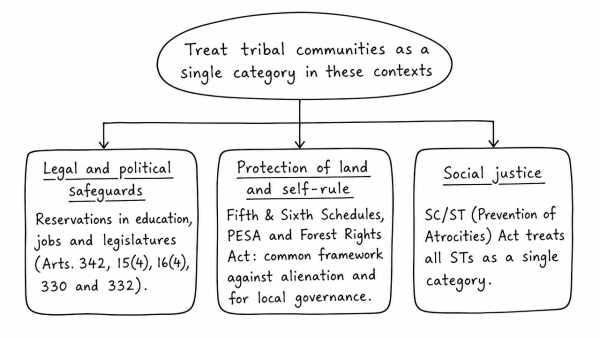
- Legal and political safeguards: For reservations in education, jobs and legislatures, all are grouped as Scheduled Tribes under Articles 342, 15(4), 16(4), 330 and 332.
- Protection of land and self-rule: In Scheduled Areas, the Fifth and Sixth Schedules, PESA and the Forest Rights Act provide a common framework against alienation and for local governance.
- Social justice: The SC/ST (Prevention of Atrocities) Act treats them as one protected class against discrimination and violence.
- Development planning: For targeted welfare, budget allocation, tribal sub-plans, EMRS, PM-JANMAN and other schemes use a single ST category.
- Vulnerability-based policy: In contexts of poverty, illiteracy, poor health, displacement and forest dependence, a collective approach is needed.
Thus, tribals are not one in culture, but they are one in law, vulnerability and welfare policy.
Originally written on
September 3, 2026
and last modified on
September 3, 2026.