Give an account of the growth and development of nuclear science and technology in India. What is the advantage of fast breeder reactor programme in India? (UPSC 2017)
India’s nuclear science and technology programme has grown from a small scientific effort into a strategic and civilian energy enterprise. It has been shaped by Dr Homi J. Bhabha’s vision of self-reliance, energy security and peaceful use of atomic energy.
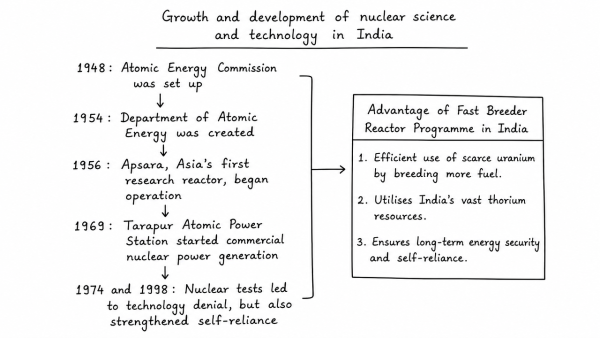
Growth and development
- 1948: Atomic Energy Commission was set up; 1954: Department of Atomic Energy was created.
- 1956: Apsara, Asia’s first research reactor, began operation, building scientific capability.
- 1969: Tarapur Atomic Power Station started commercial nuclear power generation.
- India’s 1974 and 1998 nuclear tests led to technology denial, but also pushed indigenisation and a three-stage nuclear power programme.
- The programme is designed to use pressurised heavy water reactors first, then fast breeder reactors, and finally thorium-based reactors, since India has limited uranium but large thorium reserves.
- India now operates 24 reactors with 8.78 GW installed capacity, while 9 units are under construction. Indigenous 700 MW PHWRs at Kakrapar mark growing design and manufacturing capability.
Advantages of the Fast Breeder Reactor programme
- It produces more fissile material than it consumes by converting U-238 into Pu-239.
- It greatly improves fuel utilisation, which is vital because India’s uranium reserves are limited.
- It is the key bridge to Stage 3, enabling the use of thorium by breeding U-233.
- It supports a closed fuel cycle, reducing high-level nuclear waste and long-term radiological hazard.
- It provides reliable base-load power, strengthening energy security and low-carbon growth.
Thus, India’s nuclear programme is both a scientific achievement and a long-term strategy for energy independence. The fast breeder reactor programme is especially important because it multiplies fuel, reduces waste, and unlocks the country’s thorium potential.
Originally written on
August 31, 2026
and last modified on
August 31, 2026.