Give an account of the current status and the targets to be achieved pertaining to renewable energy sources in the country. Discuss in brief the importance of National Programme on Light Emitting Diodes (LEDs). (UPSC 2016)
India’s renewable energy sector has expanded rapidly with policy support and falling costs.
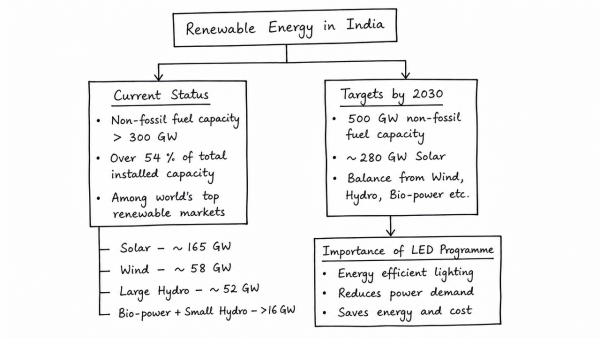
- Current status: India’s non-fossil fuel power capacity has crossed 300 GW and now forms over 54% of total installed capacity, placing India among the world’s top renewable energy markets.
- Major sources: Solar is the largest source at about 165 GW, followed by wind (about 58 GW), large hydropower (about 52 GW), and bio-power plus small hydro (over 16 GW).
- Targets: India aims to achieve 500 GW of non-fossil fuel capacity by 2030, including around 280 GW solar, along with 5 million tonnes of green hydrogen annually and net-zero emissions by 2070.
The National Programme on LEDs, through UJALA and SLNP, promotes efficient lighting by replacing incandescent bulbs and streetlights with LEDs, thereby reducing electricity consumption, peak demand and power bills, saving public funds, cutting emissions, and supporting energy security and climate goals.
Originally written on
August 30, 2026
and last modified on
August 30, 2026.