Gandhara sculpture owed as much to the Romans as to the Greeks. Explain. (UPSC 2014)
Gandhara sculpture emerged in a frontier zone linking India, Central Asia and the Mediterranean. Its Buddha images and reliefs show both Hellenistic form and Roman decorative taste, so the school cannot be explained by Greek influence alone.
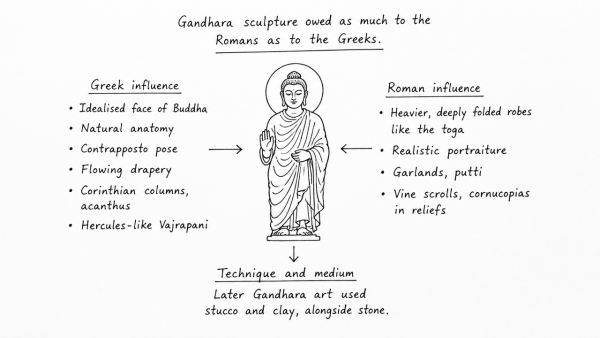
- Greek influence: idealised face of the Buddha, natural anatomy, contrapposto pose, flowing drapery, and use of Corinthian columns, acanthus and Hercules-like Vajrapani.
- Roman influence: heavier, deeply folded robes like the toga, more realistic portraiture, garlands, putti, vine scrolls and cornucopias in reliefs.
- Technique and medium: later Gandhara art used stucco and clay, a Roman method that allowed faster and more plastic modelling.
- Contact and patronage: trade under the Kushanas, especially Kanishka, brought Roman coins, objects and craftsmen through Silk Road routes.
Thus, Gandhara sculpture borrowed the ideal form from Greece, but much of its mature style, ornament and technique owed equally to Rome. It was a true Indo-Roman-Hellenistic synthesis.
Originally written on
August 29, 2026
and last modified on
September 7, 2026.