From the resolution of contentious issues regarding the distribution of legislative powers by the courts, the ‘Principle of Federal Supremacy’ and ‘Harmonious Construction’ have emerged. Explain. (UPSC 2019)
Articles 246 and the Seventh Schedule distribute legislative powers between Parliament and the States. But the entries are often broad and overlapping, so disputes arise on who may legislate on a subject.
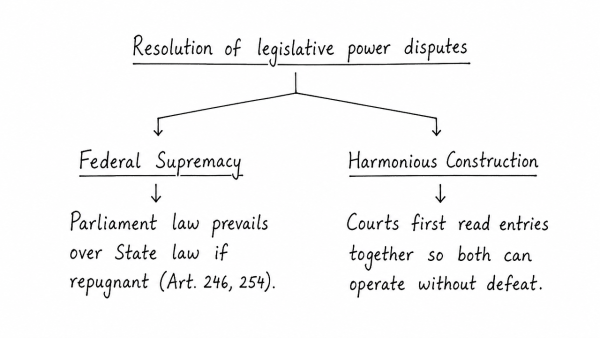
- Federal supremacy: When a law of Parliament and a State law clash, the Union law prevails under Articles 246 and 254. This is a safeguard for national unity and uniformity, but it applies only when there is real repugnancy, not mere overlap.
- Harmonious construction: Courts first try to read conflicting entries together so that both operate without defeating each other. Specific entries are preferred over general ones, and no entry is made useless.
Thus, while federal supremacy settles genuine and irreconcilable conflicts, harmonious construction preserves the balance of the federal scheme. Together, they protect both constitutional coherence and the autonomy of Union and State legislatures.
Originally written on
September 1, 2026
and last modified on
September 1, 2026.