Explain why the Ganges river dolphin is designated as an indicator species. How does its population trend reflect the ecological health of the riverine ecosystem?
The Ganges river dolphin, India’s national aquatic animal, is an apex predator and a sensitive flag of river health. As it depends on deep, clean, flowing and noisy-free waters, any decline in its numbers usually points to wider ecological stress.
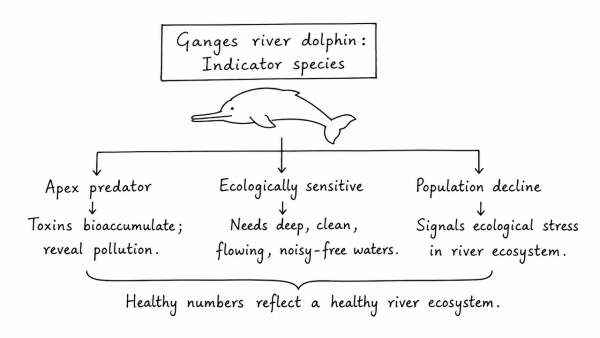
- Why it is an indicator species: It sits high in the food chain, so toxins such as heavy metals, sewage and farm chemicals accumulate in its body and reveal pollution in the river.
- Ecological sensitivity: Its echolocation-based life makes it vulnerable to low water depth, reduced flow, boat noise, sand mining and habitat fragmentation.
- Umbrella value: Protecting its habitat also safeguards fish, turtles and other aquatic life.
A falling population reflects degraded water quality, shrinking prey, blocked migration and unsafe fishing practices. A stable or rising population suggests better flow, cleaner water, richer biodiversity and improving river management. Thus, the dolphin acts as a living barometer of the Ganga basin’s ecological health.
Originally written on
September 13, 2026
and last modified on
September 13, 2026.