Explain the salient features of the Constitution (One Hundred and First Amendment) Act, 2016. Do you think it is efficacious enough “to remove cascading effect of taxes and provide for common national market for goods and services”? (UPSC 2017)
The Constitution (One Hundred and First Amendment) Act, 2016 provided the constitutional foundation for GST, replacing the fragmented indirect tax regime with a destination-based tax on supply of goods and services.
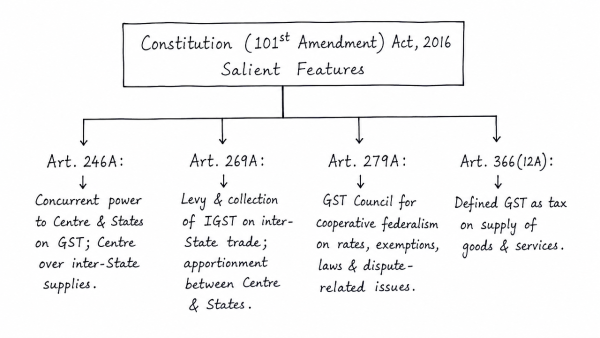
- Article 246A: gave concurrent taxing power to Parliament and States over GST; Parliament has exclusive power over inter-State supplies.
- Article 269A: enabled levy and collection of IGST on inter-State trade, with apportionment between Centre and States.
- Article 279A: created the GST Council for cooperative federalism on rates, exemptions, laws and dispute-related issues.
- Article 366(12A): defined GST as tax on supply of goods or services or both, excluding alcoholic liquor for human consumption.
- Compensation: empowered Parliament to compensate States for revenue loss for five years.
- GST reduces cascading by allowing input tax credit across the supply chain and replacing multiple central and State taxes like excise duty, service tax, VAT, entry tax and octroi.
- Common registration, e-way bills and uniform rules have lowered border checks and improved movement of goods, supporting a national market.
- However, petroleum products, electricity and real estate remain outside GST, and multiple slabs, exemptions and frequent changes keep compliance complex.
- State-level variations and disputes over compensation/refunds also limit complete market integration.
Hence, the amendment is largely effective in reducing tax cascading and promoting a common market, but its efficacy remains incomplete until coverage widens, rates simplify and cooperative federalism strengthens.
Originally written on
August 31, 2026
and last modified on
August 31, 2026.