Explain the rationale behind the Goods and Services Tax (Compensation to States) Act of 2017. How has COVID-19 impacted the GST compensation fund and created new federal tensions? (UPSC 2020)
The GST (Compensation to States) Act, 2017 was enacted to make the GST reform politically and fiscally acceptable to States. Since States gave up several independent taxes such as VAT, entry tax and octroi, the law assured them protection against revenue loss during the transition.
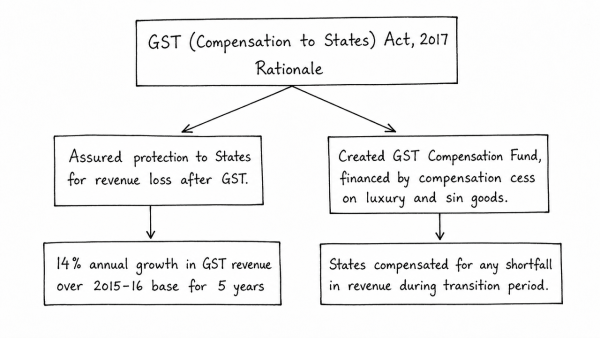
- Rationale of the Act
- It guaranteed States a 14% annual growth in GST revenue over the 2015-16 base for five years, from July 2017 to June 2022.
- A dedicated GST Compensation Fund was created, financed mainly through a compensation cess on luxury and sin goods such as tobacco, aerated drinks, coal and high-end cars.
- This arrangement built trust in the GST Council and upheld cooperative federalism under Article 279A.
- Impact of COVID-19 on the fund
- The pandemic caused a sharp fall in economic activity, so both GST collections and cess receipts declined.
- For 2020-21, States demanded about ₹3 lakh crore as compensation, while expected cess receipts were only about ₹65,000 crore.
- The resulting gap was around ₹2.35 lakh crore, exhausting earlier surpluses in the fund.
- New federal tensions
- States argued that the Centre must protect the original compensation promise and support borrowing.
- The Centre said part of the gap was due to the pandemic, beyond the Act’s normal scope, and resisted full liability from the Consolidated Fund.
- Debate over who should borrow and repay deepened distrust, exposing strain in GST federalism.
Eventually, the Centre arranged borrowing through a special window and passed funds to States. The episode showed that GST success depends not only on tax design, but also on credible and timely fiscal support to States.
Originally written on
September 2, 2026
and last modified on
September 2, 2026.