Explain the mechanism and occurrence of cloudburst in the context of the Indian subcontinent. Discuss two recent examples. (UPSC 2022)
Cloudbursts are extreme, short-duration rainstorms over a very small area. In India, the IMD treats rainfall of 100 mm or more in one hour over about 20–30 sq km as a cloudburst.
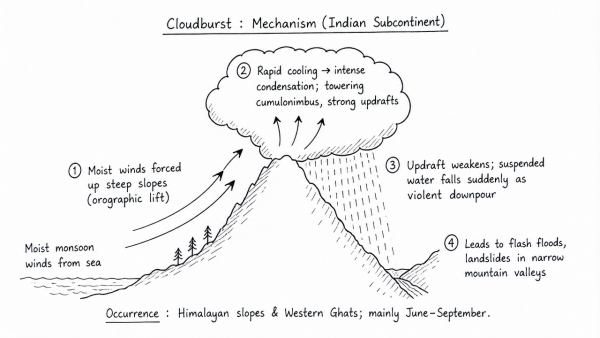
- Mechanism: Moist monsoon winds are forced up steep slopes. Rapid cooling causes intense condensation, towering cumulonimbus clouds and very strong updrafts.
- Rain release: When the updraft weakens, suspended water falls suddenly as a violent downpour.
- Occurrence: They are common on the Himalayan slopes and sometimes the Western Ghats, mainly in June–September. Narrow valleys, orographic lift and interaction with western disturbances increase the risk.
- Recent examples: In July 2024, cloudbursts in Samej Khad, Himachal Pradesh, triggered flash floods and large loss of life and infrastructure. In August 2025, Chishoti village in Kishtwar, Jammu and Kashmir, suffered deadly floods and debris flow during the Machail Yatra.
Warming climate and fragile mountain terrain are making such events more frequent and destructive, demanding better forecasting, land-use control and disaster preparedness.
Originally written on
September 3, 2026
and last modified on
September 3, 2026.