Explain the key challenges for India’s energy security. What measures do you suggest for ensuring energy security along with economic growth and sustainability? (UPSC 2026)
India’s energy security is now more complex than merely ensuring adequate supply. It must balance affordability, reliability, import exposure and climate goals while supporting high economic growth. Though non-fossil capacity has crossed 300.50 GW, coal still dominates actual generation, showing the gap between installed capacity and usable energy.
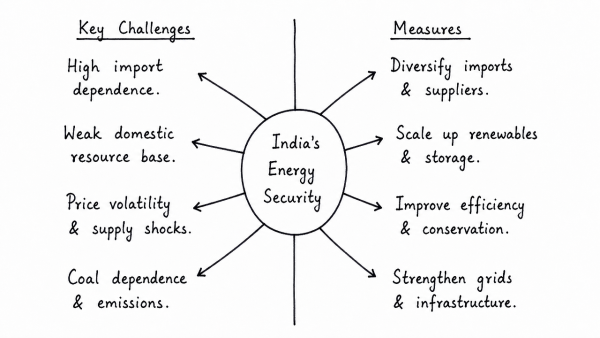
- Key challenges
- High import dependence: crude oil import dependence is about 89.4% and LNG reliance is nearly 50%, making India vulnerable to West Asian tensions and price shocks.
- Weak domestic resource base: declining oil and gas reserves increase exposure to external markets.
- Intermittency of renewables: solar power peaks in the day, while demand is high in the evening, causing curtailment and grid stress.
- High storage cost: batteries remain costlier than coal-based electricity, limiting large-scale round-the-clock clean power.
- Critical mineral dependence: EVs, solar panels and batteries depend on imported lithium, cobalt, nickel and rare earths, with major refining concentrated abroad.
- Fiscal burden: large subsidies reduce space for investment in clean energy, transmission and innovation.
- Suggested measures
- Build strategic reserves of oil and gas, and diversify imports across suppliers and routes.
- Scale up storage, including battery systems, pumped hydro and long-duration storage, for peak power supply.
- Strengthen the green grid through transmission corridors, smarter dispatch and better demand management.
- Promote domestic exploration, critical mineral mapping, overseas partnerships and battery recycling.
- Use cleaner coal technologies and gas as transition fuels where needed for industry and peaking power.
- Rationalise subsidies and redirect savings to clean energy, R&D and energy efficiency.
India should pursue a diversified, technology-driven and fiscally prudent energy strategy. This will secure supply, sustain growth and move the economy towards a low-carbon future.
Originally written on
September 6, 2026
and last modified on
September 6, 2026.