Explain the formation of thousands of islands in Indonesian and Philippines archipelagos. (UPSC 2014)
Indonesia and the Philippines lie on the Pacific Ring of Fire, where the Eurasian, Indo-Australian, Pacific and Philippine Sea plates meet. Their islands formed mainly through subduction, volcanism, faulting and sea-level change.
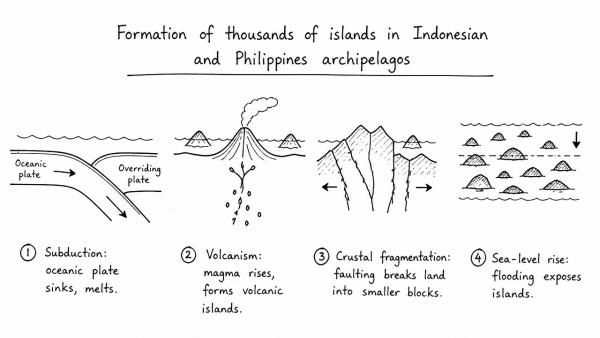
Key processes
- Subduction: Dense oceanic plates sink beneath lighter crust, causing melting, earthquakes and island-arc formation.
- Volcanism: Magma rises to build submarine volcanoes that emerge above sea level, creating chains of volcanic islands.
- Crustal fragmentation: Tectonic stress and major faults break landmasses into smaller blocks, especially in the Philippines.
- Sea-level rise: Post-Ice Age flooding submerged lowlands and exposed only higher ridges and peaks as islands.
Thus, these archipelagos are young, tectonically active and still being reshaped by plate movement and volcanism.
Originally written on
August 29, 2026
and last modified on
September 7, 2026.