Explain the constitutional provisions under which Legislative Councils are established. Review the working and current status of Legislative Councils with suitable illustrations. (UPSC 2021)
Legislative Councils are optional Upper Houses in some states, meant to add scrutiny, continuity and expert input to law-making.
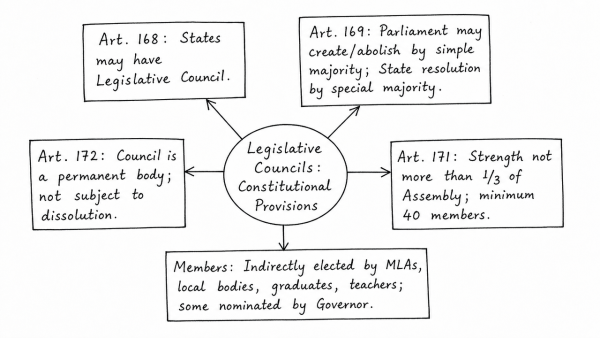
- Constitutional provisions: Article 168 permits bicameralism in states. Under Article 169, Parliament may create or abolish a Council by simple majority if the State Assembly passes a resolution by special majority. Article 171 limits its strength to one-third of the Assembly, with a minimum of 40 members. Members are indirectly elected by MLAs, local bodies, graduates and teachers’ constituencies, and some are nominated by the Governor. Article 172 makes it a permanent House; members serve six years, with one-third retiring every two years. Article 173 fixes the minimum age at 30. Under Articles 197 and 198, it cannot block Money Bills and has only limited delay power over ordinary Bills.
- Working: Councils can improve legislative review, accommodate experienced persons without direct election, and provide a less partisan forum. However, they are criticised for limited powers, cost, and occasional use as a refuge for political allies or defeated leaders.
- Current status: Only six states have Councils—Uttar Pradesh, Maharashtra, Bihar, Karnataka, Andhra Pradesh and Telangana. Other state resolutions for creation or abolition await Parliamentary action, showing that their continuation depends mainly on political will.
Thus, Legislative Councils exist as constitutionally permitted but weak revising chambers, useful where they improve scrutiny and representation, but often questioned on grounds of utility and cost.
Originally written on
September 2, 2026
and last modified on
September 2, 2026.