Explain how the Uprising of 1857 constitutes an important watershed in the evolution of British policies towards colonial India. (UPSC 2016)
1857 was a decisive watershed because it exposed the fragility of Company rule and compelled Britain to recast its Indian empire.
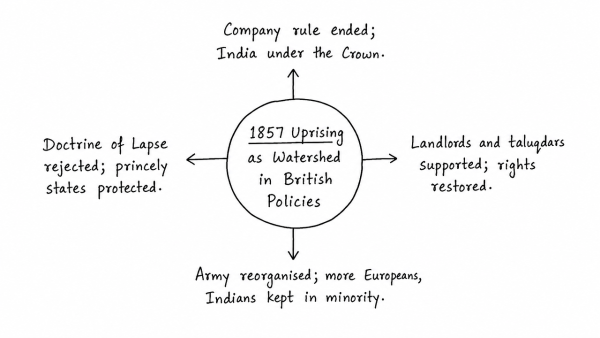
- Political shift: The Government of India Act, 1858 ended Company rule, placed India under the Crown, and created the offices of Secretary of State for India and Viceroy, strengthening direct imperial control.
- Policy reorientation: Annexation stopped; the Queen’s Proclamation rejected the Doctrine of Lapse, protected princely states, and sought support from landlords and taluqdars by restoring their rights.
- Military and social change: The army was reorganised with more Europeans, fewer Indians in key positions, and recruitment from “martial races”; British policy also stressed non-interference in religion while widening racial segregation and divide-and-rule.
Thus, 1857 marked a shift from aggressive Company expansion to a centralised, cautious, and more repressive colonial state.
Originally written on
August 30, 2026
and last modified on
August 30, 2026.