Explain how the foundations of the modern world were laid by the American and French Revolutions. (UPSC 2019)
The American and French Revolutions transformed political authority from monarchy to citizenship, and from privilege to rights. They did not merely change two countries; they supplied the core ideas and institutions of the modern state, democracy and constitutional government.
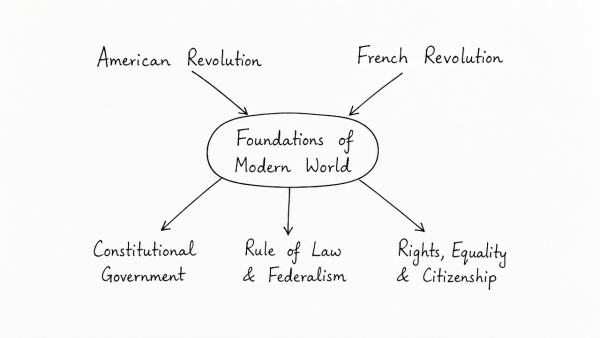
- Constitutional government: The American Revolution led to the first modern written constitution in 1787. It limited state power through a supreme law, and popularised separation of powers and checks and balances.
- Rule of law and federalism: It showed that authority must be bound by law, not personal will. Its federal model also offered a practical way to balance unity with regional autonomy, later adopted by many diverse democracies.
- Rights of the individual: The American Bill of Rights and the French Declaration of the Rights of Man shifted the individual from a subject of the ruler to a citizen with inherent rights. This became the basis of modern civil liberties and constitutional rights.
- Popular sovereignty: Both revolutions rejected the divine right of kings. Political legitimacy came from the people, expressed through representation and citizenship, not heredity.
- Equality and secularism: The French Revolution attacked feudal privilege and promoted liberty, equality and fraternity. It also weakened the political control of the Church, helping shape modern secular states.
- Modern legal systems: The French Revolution paved the way for codified law and legal equality, later strengthened by the Napoleonic Code. This influenced civil law systems across Europe and beyond.
Thus, the two revolutions laid the foundations of modern constitutionalism, nationalism, human rights, secularism and democratic legitimacy. Their ideas continue to guide the political and legal order of the contemporary world.
Originally written on
September 1, 2026
and last modified on
September 1, 2026.