Examine the status of forest resources of India and its resultant impact on climate change. (UPSC 2020)
India’s forest resources have improved in extent, but their ecological quality remains uneven. Forests and tree cover now stand at 8,27,357 sq km, or 25.17% of the country’s geographical area, yet high-density natural forests continue to face fragmentation and degradation.
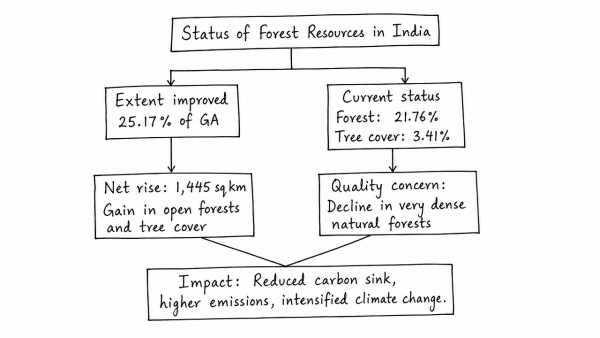
- Current status: Forest cover is 7,15,343 sq km (21.76%) and tree cover 1,12,014 sq km (3.41%). The latest assessment shows a net rise of 1,445 sq km, but much of the gain is in open forests and tree cover rather than dense forests.
- Quality concern: The decline in very dense and moderately dense forests reduces biomass, wildlife habitat and long-term carbon storage. Mangroves cover about 4,991.68 sq km, but remain exposed to coastal pressure and sea-level rise.
- Carbon stock: Forest carbon stock is estimated at 7,285.5 million tonnes, showing that forests still act as a major carbon sink.
Impact on climate change
- Mitigation role: Forests absorb carbon dioxide, support India’s climate targets and help create an additional carbon sink through forest and tree cover.
- Local cooling: Canopy cover lowers surface temperatures, reduces heat stress and supports moisture recycling through evapotranspiration.
- Coastal protection: Mangroves reduce wave energy and storm surge impacts, making coastal areas more resilient to cyclones.
- Climate vulnerability: Rising temperatures, droughts and fires can turn degraded forests into net carbon sources. Invasive species, pests and upward shift of vegetation in the Himalayas further weaken resilience.
Thus, India’s forests remain central to climate action, but their true value depends on conserving dense natural forests, restoring degraded landscapes and protecting mangroves. Expanding cover alone is not enough; ecological integrity must guide forest policy.
Originally written on
September 2, 2026
and last modified on
September 2, 2026.