Examine the scope of Fundamental Rights in the light of the latest judgement of the Supreme Court on Right to Privacy. (UPSC 2017)
The Supreme Court’s judgement on Right to Privacy in Justice K.S. Puttaswamy v. Union of India transformed the understanding of Fundamental Rights. It declared privacy to be a natural, inalienable and constitutionally protected right under Article 21, read with Articles 14 and 19. This widened the scope of Part III from narrow civil liberties to a fuller protection of dignity, autonomy and choice.
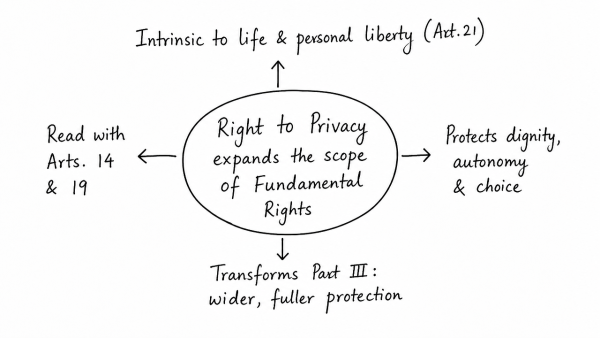
- Privacy as a core constitutional value: The Court overruled earlier decisions in M.P. Sharma and Kharak Singh, and held that privacy is intrinsic to life and personal liberty.
- Expansion of Article 21: Life and liberty now include bodily integrity, decisional autonomy, informational privacy, family life, sexual orientation, and control over personal data.
- Link with other rights: Privacy is not isolated; it strengthens freedom of speech, movement, association and equality by protecting individuals from arbitrary State and social intrusion.
Impact on State power:
| Test | Meaning |
| Legality | Any invasion of privacy must have a law. |
| Legitimate aim | It must serve a valid public purpose. |
| Necessity | The measure must be the least intrusive option. |
| Proportionality | The harm to rights must not exceed the public benefit. |
- Guidance for future laws: Surveillance, data collection and identity systems must now meet strict constitutional scrutiny.
- Strengthening digital rights: The judgement laid the foundation for protection of personal data, informational self-determination and safeguards against misuse of technology.
Thus, the privacy verdict has made Fundamental Rights more rights-based, human and practical. It ensures that constitutional democracy protects not only the citizen against the State, but also the person’s dignity, freedom and control over private life.
Originally written on
August 31, 2026
and last modified on
August 31, 2026.