Examine the role of supermarkets in supply chain management of fruits, vegetables and food items. How do they eliminate number of intermediaries? (UPSC 2018)
Supermarkets play a major role in modern supply chain management for fruits, vegetables and food items. They build a shorter, more organised chain that improves freshness, reduces waste and gives better price realisation to farmers.
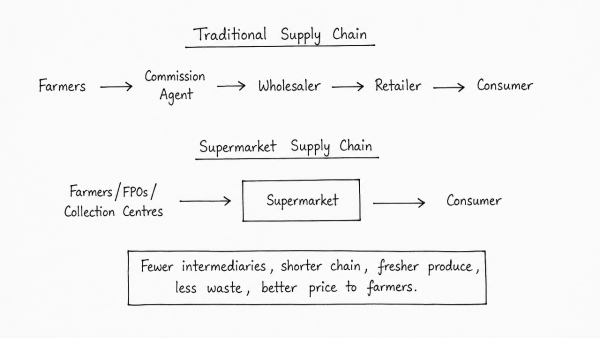
- Efficient procurement: They buy directly from farmers, FPOs or collection centres near the farm gate.
- Cold chain support: Pre-cooling, refrigerated transport and cold storage reduce post-harvest losses in perishables.
- Quality control: Sorting, grading and standard packing ensure uniform supply and lower rejection.
- Demand management: Digital inventory and forecasting match supply with consumer demand, cutting spoilage.
Elimination of intermediaries: Traditional chains involve village traders, commission agents, wholesalers and sub-wholesalers. Supermarkets bypass these layers through direct contracts, bulk buying and direct payment to producers, often into bank accounts. This reduces commission charges, handling losses and delays.
Thus, supermarkets create a leaner farmer-to-store model. They improve efficiency, but their benefits are greatest when backed by strong logistics, FPOs and fair procurement practices.
Originally written on
September 1, 2026
and last modified on
September 1, 2026.