Examine the main provisions of the National Child Policy and throw light on the status of its implementation. (UPSC 2015)
The National Policy for Children, 2013 treats every person below 18 years as a child and adopts a rights-based approach. It views children as national assets and places them at the centre of state action.
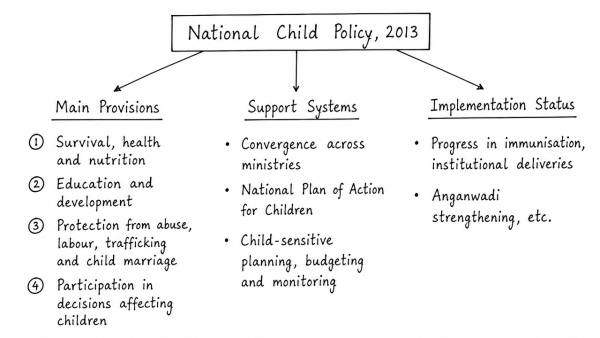
- Key provisions: survival, health and nutrition; education and development; protection from abuse, labour, trafficking and child marriage; and participation in decisions affecting children.
- Support systems: it calls for convergence across ministries, a National Plan of Action for Children, and child-sensitive planning, budgeting and monitoring.
- Implementation status: progress is visible in immunisation, institutional deliveries, Anganwadi strengthening, child helplines and stronger legal protection under laws such as RTE and POCSO.
- Gaps: malnutrition, school dropouts after the elementary stage, child labour, abuse, online exploitation and weak child participation mechanisms continue.
- Finance and coordination: child-specific allocations remain limited, and outcomes vary across States due to uneven capacity and poor convergence.
Thus, the policy has provided a sound rights framework, but its success depends on stronger funding, better inter-sectoral coordination and accountable local implementation.
Originally written on
August 30, 2026
and last modified on
August 30, 2026.