Examine the impact of liberalization on companies owned by Indians. Are they competing with the MNCs satisfactorily? Discuss. (UPSC 2013)
Liberalisation transformed Indian-owned companies from protected, inward-looking firms into more efficient, market-driven and global players. Exposure to competition, foreign capital and technology forced restructuring, better management and stronger brands.
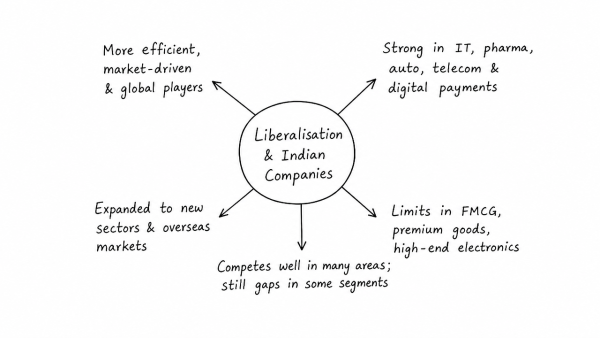
- Positive impact: Indian firms expanded into new sectors and overseas markets. Tata, Infosys, TCS, Sun Pharma, Mahindra and others became competitive at home and abroad.
- Sectoral success: They perform well in IT services, pharmaceuticals, automobiles, telecom and digital payments. In several areas, domestic firms have checked MNC dominance and built Indian multinationals.
- Limits: In FMCG, premium consumer goods, high-end electronics and advanced technology, MNCs still lead because of strong brands, deeper R&D, scale and global supply chains.
Thus, Indian companies are competing satisfactorily in several sunrise and mid-tech sectors, but not uniformly across the economy. To narrow the gap, they need higher R&D spending, innovation, skilled manpower and stronger manufacturing depth.
Originally written on
August 28, 2026
and last modified on
September 7, 2026.