Examine how the decline of traditional artisanal industry in colonial India crippled the rural economy. (UPSC 2017)
Traditional artisanal industry was a vital part of India’s pre-colonial rural economy. It linked farming with crafts, provided tools, textiles and utensils locally, and gave peasants an income buffer beyond agriculture. Colonial rule broke this balance and pushed the countryside into distress.
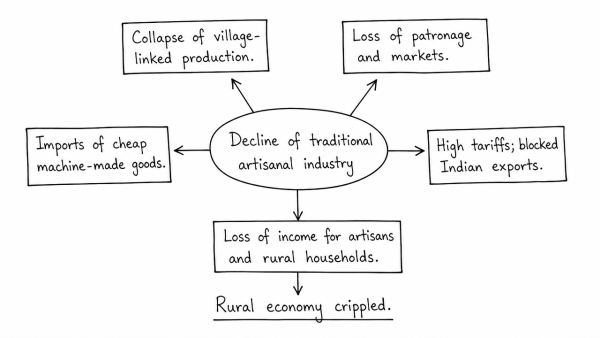
- Collapse of village-linked production: Cheap machine-made British goods flooded Indian markets after the Charter Act of 1813. Handloom, spinning, leather and metal crafts lost demand, while high tariffs protected British goods abroad and blocked Indian exports.
- Loss of patronage and markets: The decline of princely courts, zamindar households and karkhanas reduced demand for fine crafts such as muslin, silk and ornamental work. Many skilled artisans lost their main buyers.
- Rural occupational displacement: Displaced weavers, spinners and craftsmen moved back to villages and joined agriculture or became wage labourers. This increased pressure on land and created hidden unemployment.
- Weakened resilience of peasants: Crafts had earlier supported families during slack seasons. Their disappearance removed an important source of cash income, making peasants more dependent on monsoon agriculture and more vulnerable to harvest failure.
- Debt and pauperisation: With lower earnings, small किसानों relied on moneylenders to pay land revenue and household costs. This deepened indebtedness, land loss and chronic rural poverty.
Thus, the decline of artisanal industry did not merely destroy a sector; it dismantled the rural economic safety net. It turned a diversified village economy into an agriculture-dominated and insecure one, helping to create the structural poverty seen in colonial India.
Originally written on
August 31, 2026
and last modified on
August 31, 2026.