Examine how proprietary technology controls and high borrowing costs impede deep-tech transfer to developing nations. Why do current multilateral climate finance mechanisms remain largely ineffective?
Deep-tech transfer is vital for climate action, yet developing nations face structural barriers in both access and finance. Proprietary control over technology and costly borrowing make adoption slow, expensive and often unrealistic.
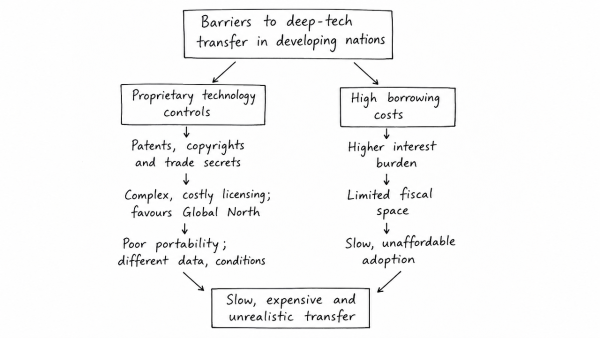
- Proprietary technology controls
Deep-tech is usually protected by patents, copyrights and trade secrets. Licensing deals are complex and often favour firms and institutions in the Global North, raising costs for buyers in the Global South. Even when transfer occurs, technologies are not always easily portable because they are designed around different data, markets and environmental conditions.
- High borrowing costs
Many developing countries, especially least developed countries, face debt stress and pay interest rates of up to 8% on international loans, compared with about 1% for advanced economies. Climate finance is also loan-heavy: over 60% of recent flows have been loans, often non-concessional, so countries end up repaying more than they receive.
- Why multilateral climate finance remains ineffective
| Shortfall | Promised finance is not met; needs are far above current flows. |
| Bias | Mitigation gets far more support than adaptation, though vulnerable countries need adaptation most. |
| Access | Complex rules, co-financing demands and slow approvals delay disbursement. |
| Debt trap | Loan-based finance worsens fiscal stress instead of building resilience. |
| Opacity | No common definition of climate finance weakens transparency and accountability. |
Therefore, current mechanisms fail because they are underfunded, debt-creating, fragmented and too bureaucratic. A shift towards grant-based finance, simpler access and fairer technology sharing is essential if climate finance is to deliver real transfer and resilience.