Evaluate the policies of Lord Curzon and their long-term implications on the national movement. (UPSC 2020)
Lord Curzon was an efficient administrator, but his policies were authoritarian, centralising and dismissive of Indian aspirations. They strengthened colonial control yet provoked wider nationalist protest.
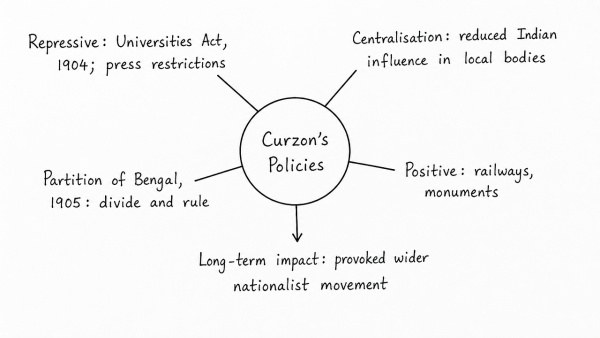
- Repressive measures: The Indian Universities Act, 1904 and press restrictions curtailed academic freedom and criticism, alienating students and the middle class.
- Centralisation: He reduced Indian influence in local bodies and expanded official control, reflecting distrust of self-government.
- Partition of Bengal, 1905: Though justified administratively, it was widely viewed as a divide-and-rule move.
- Positive aspects: He improved railways and protected monuments, but these were overshadowed politically.
In the long run, Curzon’s policies gave the national movement mass support through Swadeshi and Boycott, deepened Congress radicalisation and split, encouraged revolutionary politics, and contributed to communal politics and the Muslim League’s emergence.
Originally written on
September 1, 2026
and last modified on
September 1, 2026.