Establish relationship between land reforms, agriculture productivity and elimination of poverty in the Indian economy. Discuss the difficulties in designing and implementation of agriculture-friendly land reforms in India. (UPSC 2013)
Land reforms are central because land is the main rural asset. Secure ownership or tenancy raises investment, productivity and incomes, while redistribution and clearer titles reduce poverty by turning landless labourers into producers.
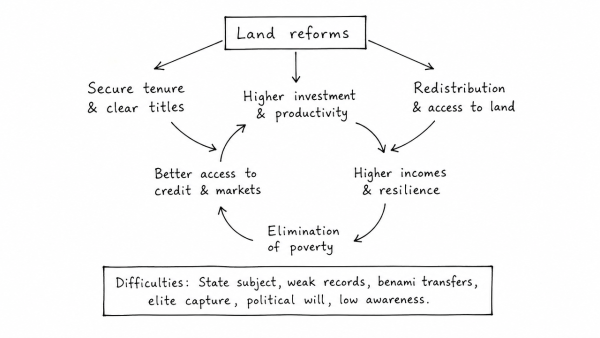
Link to growth: Tenure security encourages irrigation, soil improvement and better cropping; land access for tenants, women and marginal farmers improves bargaining power, credit access and resilience. Operation Barga in West Bengal showed higher output through tenant security.
Why difficult: Land is a State subject, so laws and political will vary. Implementation is slowed by weak records, concealed tenancy, fragmented holdings, fear of land loss, litigation and evasion of ceiling laws. Tiny farm sizes mean redistribution alone cannot ensure high productivity without irrigation, markets and technology.
Hence, agriculture-friendly land reforms are essential but must be backed by secure land records, tenancy protection, credit and broader farm support.