Enumerate the National Water Policy of India. Taking river Ganges as an example, discuss the strategies which may be adopted for river water pollution control and management. What are the legal provisions of management and handling of hazardous wastes in India? (UPSC 2013)
India’s National Water Policy treats water as a scarce common resource and prioritises drinking water, then irrigation, hydropower, navigation and industry, with river-basin planning, conservation, recycling, rainwater harvesting, efficient irrigation, rational pricing and ecological flow protection.
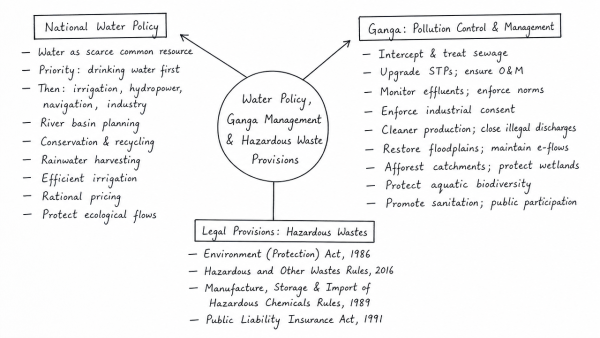
- Ganga control: intercept and treat sewage, upgrade STPs, monitor effluents, ensure municipal O&M, enforce industrial consent, cleaner production and closure of illegal discharges.
- Ecosystem measures: restore floodplains, maintain e-flows, afforest catchments, protect wetlands and aquatic biodiversity, and promote sanitation and public participation.
- Hazardous waste law: Environment (Protection) Act, 1986; Hazardous and Other Wastes Rules, 2016; SPCB authorisation; safe collection, storage, transport, treatment and disposal; Basel Convention controls on import and export.
Effective management needs prevention, strict regulation, monitoring and community stewardship.
Originally written on
August 29, 2026
and last modified on
September 7, 2026.