Enumerate the indirect taxes which have been subsumed in the Goods and Services Tax (GST) in India. Also, comment on the revenue implications of the GST introduced in India since July 2017. (UPSC 2019)
GST replaced a web of central and state indirect taxes to create a common market and curb cascading.
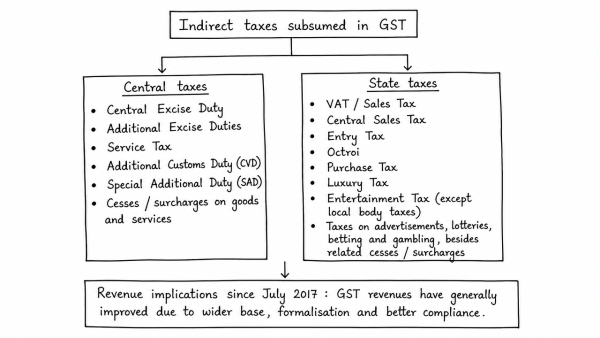
- Central taxes: Central Excise Duty, Additional Excise Duties, Service Tax, Additional Customs Duty (CVD), Special Additional Duty (SAD), and related cesses/surcharges on supply of goods and services.
- State taxes: VAT/Sales Tax, Central Sales Tax, Entry Tax, Octroi, Purchase Tax, Luxury Tax, Entertainment Tax (except local body taxes), and taxes on advertisements, lotteries, betting and gambling, besides related cesses/surcharges.
Since July 2017, GST revenues have generally improved due to wider base, formalisation and better compliance, with collections often exceeding ₹1.5 lakh crore in recent years, benefiting both Centre and States.
Yet gains have been uneven across sectors and States; rate cuts, input tax credit disputes and compliance costs have sometimes reduced buoyancy, so long-term revenue stability depends on simpler rates and stronger administration.
Originally written on
September 1, 2026
and last modified on
September 1, 2026.