Electronic cash transfer system for the welfare schemes is an ambitious project to minimize corruption, eliminate wastage and facilitate reforms. Comment. (UPSC 2013)
Electronic cash transfer has transformed welfare delivery in India from a leak-prone, subsidy-heavy model to a more targeted and transparent system. It has clearly helped curb corruption, reduce wastage and widen access, but its success depends on inclusion, last-mile delivery and strong grievance redressal.
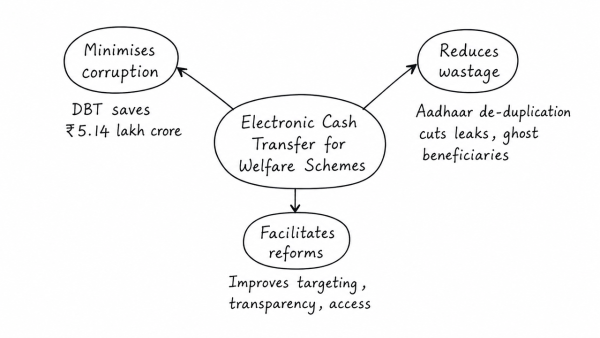
- Minimising corruption: DBT through PFMS now covers over 966 schemes and has helped save about ₹5.14 lakh crore by removing fake or duplicate beneficiaries.
- Reducing wastage: Aadhaar-based de-duplication in PDS, LPG and MGNREGS has cut ghost beneficiaries and leakage, improving fiscal efficiency.
- Facilitating reform: It has supported subsidy rationalisation, financial inclusion through JAM, and better policy targeting using digital records.
- Limits: Exclusion errors, biometric failure, poor connectivity and weak grievance systems can deny genuine beneficiaries their rights.
Thus, electronic transfer is a major governance reform, but it must be backed by offline options, robust authentication, local support and periodic audits to ensure that efficiency does not come at the cost of equity.
Originally written on
August 28, 2026
and last modified on
September 7, 2026.