“Economic growth in the recent past has been led by increase in labour productivity.” Explain this statement. Suggest the growth pattern that will lead to creation of more jobs without compromising labour productivity. (UPSC 2022)
Economic growth led by higher labour productivity means output rises faster than employment because each worker produces more through better machines, skills, organisation and technology. In India, recent growth has often been driven more by capital deepening and efficiency gains than by large-scale job creation.
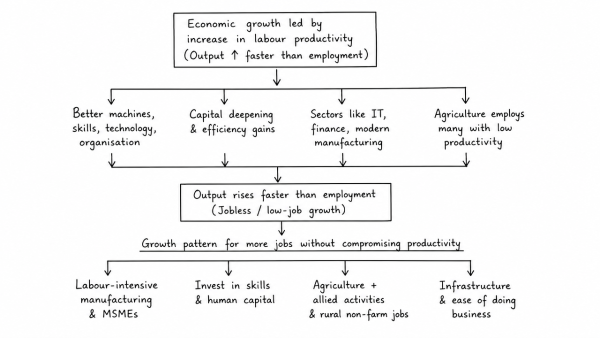
- Why growth outpaced jobs
Sectors such as IT, finance and modern manufacturing raise output per worker sharply but absorb limited labour. Meanwhile, agriculture still employs many workers with low productivity, and non-farm job creation has remained slower than GDP/GVA growth, producing “jobless” or “low-job” growth. - Growth pattern needed
India needs labour-intensive but productivity-raising structural transformation: expand textiles, apparel, leather, footwear, food processing and export-oriented manufacturing; strengthen MSMEs with credit, technology, logistics and market access; and grow services like tourism, healthcare and hospitality that create more jobs per unit of investment. - How to preserve productivity
Skilling, apprenticeships, better infrastructure, formal hiring incentives and technology adoption in small firms can move workers from low-productivity farm jobs to higher-productivity non-farm employment without reducing efficiency.
The ideal path is labour-absorbing growth with rising productivity, so output, incomes and employment all expand together.
Originally written on
September 3, 2026
and last modified on
September 3, 2026.