Do you think the Constitution of India does not accept the principle of strict separation of powers rather it is based on the principle of ‘checks and balance’? Explain. (UPSC 2019)
The Constitution of India does not adopt a rigid, watertight separation of powers. It prefers a practical system in which the three organs are distinct yet interdependent, with each checking the excesses of the others.
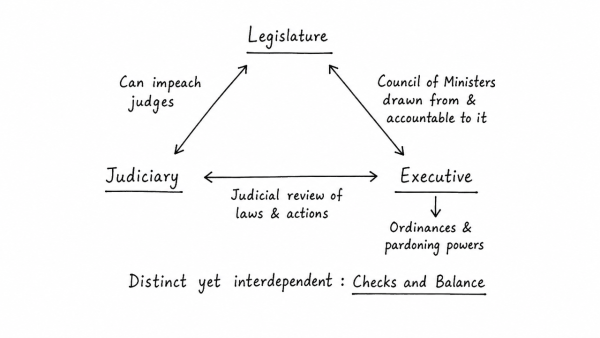
- Functional overlap: In the parliamentary system, the Council of Ministers is drawn from the legislature and remains accountable to it.
- Executive powers: The President and Governors can issue ordinances, and the executive exercises pardoning powers.
- Legislative and judicial roles: Parliament can impeach judges, while courts can review laws and executive action.
- Constitutional safeguards: Articles 50, 121, 122, 211, 212 and 361 show separation in some areas but not complete isolation.
- Basic structure: Judicial decisions have held that separation of powers and judicial review are part of the Constitution’s basic structure.
Thus, India follows a balanced model of overlapping functions with mutual restraint. The aim is not strict isolation, but coordinated governance backed by checks and balances to prevent misuse of power.
Originally written on
September 1, 2026
and last modified on
September 1, 2026.