Do you agree that the Indian economy has recently experienced V-shaped recovery? Give reasons in support of your answer. (UPSC 2021)
India has seen a sharp rebound after the pandemic shock, but calling it a pure V-shaped recovery would be only partly correct. The economy has recovered quickly in aggregate output, yet the recovery has been uneven across sectors, firms and households.
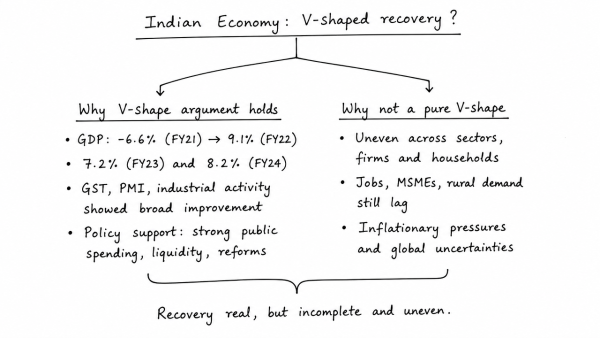
- Why the V-shape argument holds: Real GDP contracted by -6.6% in FY21 and then rebounded strongly by 9.1% in FY22, followed by 7.2% in FY23 and 8.2% in FY24. High-frequency indicators such as GST collections, PMI readings and industrial activity also showed broad improvement.
- Policy support: A strong public capex push, along with fiscal consolidation, helped revive demand and create a growth base. Government capital spending rose sharply, supporting infrastructure, logistics and private confidence.
- Labour market signs: Headline unemployment has declined and labour force participation, especially among women, has improved, suggesting better economic normalisation.
- Why it is not fully V-shaped: Consumption recovery has been uneven. Premium goods and organised sectors have done better, while mass consumption, rural demand and many informal activities have remained weak.
- K-shaped features: Large firms, formal jobs and urban services recovered faster than MSMEs, casual workers and self-employed households. This points to widening income and employment disparities.
- Private investment gap: Despite healthier corporate balance sheets, private capex has not revived strongly enough to make the rebound broad-based.
Thus, India has experienced a strong and rapid macroeconomic recovery, but its benefits have been distributed unevenly. The better description is a V-shaped GDP recovery with distinct K-shaped social and sectoral outcomes.
Originally written on
September 3, 2026
and last modified on
September 3, 2026.