Do you agree that regionalism in India appears to be a consequence of rising cultural assertiveness? Argue. (UPSC 2020)
Yes, to a large extent regionalism in India today is linked to rising cultural assertiveness. Communities and states are increasingly defending language, customs and local identity when they feel threatened by uniform policies or outside dominance.
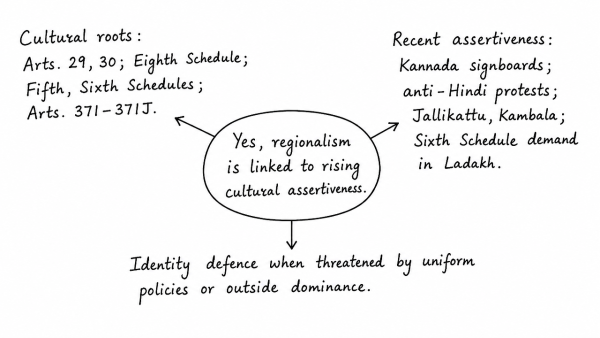
- Cultural roots: Articles 29 and 30 protect cultural rights, while the Eighth Schedule, Fifth and Sixth Schedules, and Articles 371 to 371J recognise India’s plural identities.
- Recent assertiveness: Demands for Kannada on signboards, protests against perceived Hindi imposition, defence of Jallikattu and Kambala, and tribal calls for Sixth Schedule protection in Ladakh show identity-based mobilisation.
- But not the only cause: Regionalism also grows from fiscal complaints, unequal development, delimitation fears, river-water disputes, and demands for greater political representation.
Thus, cultural assertiveness is a major trigger and symbol of regionalism, but it works alongside economic and political grievances. India must protect diversity while strengthening cooperative federalism and inclusive dialogue.
Originally written on
September 2, 2026
and last modified on
September 2, 2026.