Do we have cultural pockets of small India all over the nation? Elaborate with examples. (UPSC 2019)
Yes. India’s internal migration, settlement history and economic mobility have created many cultural pockets that resemble “small India” within cities, towns and industrial belts. These enclaves preserve language, food, festivals and social customs while living alongside local cultures.
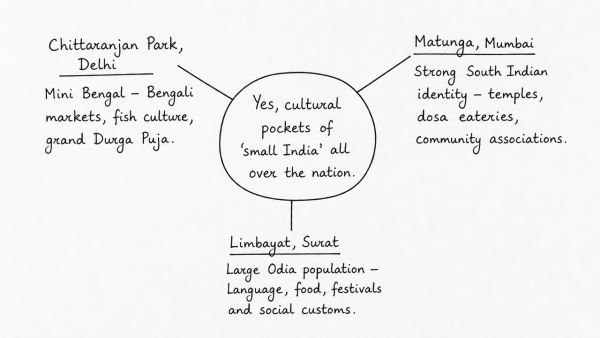
- Regional enclaves: Chittaranjan Park in Delhi is widely seen as Mini Bengal, with Bengali markets, fish culture and grand Durga Puja.
- Matunga in Mumbai is known for its strong South Indian identity, reflected in temples, dosa eateries and community associations.
- Limbayat and nearby colonies in Surat have a large Odia population, where Rath Yatra and Odia language remain vibrant.
- Ghatkopar and Borivali in Mumbai have strong Gujarati cultural features, especially in trade, food and Navratri celebrations.
- Post-partition settlements in the Terai also preserve Punjabi agrarian traditions and gurudwaras.
- Industrial townships: Bhilai, Rourkela and Jamshedpur attract workers from across India. Their mixed population makes festivals like Chhath, Pongal, Ganpati and Durga Puja part of public life.
- Refugee and diaspora pockets: Bylakuppe and McLeodganj are known as Mini Tibet, while Tangra in Kolkata preserves Chinese-Indian identity. Fort Kochi also reflects Jewish and European cultural traces.
- Modern urban hubs: Bengaluru, Pune and Hyderabad have cosmopolitan IT and education zones where many languages, cuisines and dress styles coexist.
These pockets show that Indian unity is not uniformity but coexistence. They enrich national culture, yet also raise issues of migrant access, local identity and “sons of the soil” tensions. Proper urban planning and inclusive citizenship can turn such diversity into social strength.
Originally written on
September 1, 2026
and last modified on
September 1, 2026.