Do government’s schemes for up-lifting vulnerable and backward communities by protecting required social resources for them, lead to their exclusion in establishing businesses in urban economies? (UPSC 2014)
Government schemes for vulnerable and backward communities do not inherently exclude them from urban business; rather, they often create a safety net. Yet, when protection is tied mainly to land, livelihood and reservation in jobs, it can indirectly limit entry into competitive urban markets.
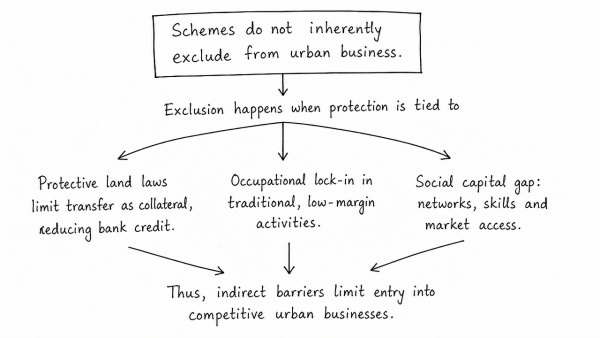
- How exclusion happens: protective land laws preserve resources, but restrict their transfer as collateral, reducing access to bank credit for urban ventures.
- Occupational lock-in: some support schemes keep communities in traditional, low-margin activities instead of helping them shift to scalable businesses.
- Social capital gap: urban entrepreneurship needs networks, market access and risk-taking, which welfare schemes alone do not build.
- Positive shift: credit and market-linkage schemes like Stand-Up India, procurement support and subsidy-based industrial policies help overcome these barriers.
Therefore, the problem is not protection itself, but narrow design. Schemes should combine asset security with credit, skills, incubation and market access so that social justice also leads to business inclusion in cities.
Originally written on
August 29, 2026
and last modified on
August 29, 2026.