Do Department-related Parliamentary Standing Committees keep the administration on its toes and inspire reverence for parliamentary control? Evaluate the working of such committees with suitable examples. (UPSC 2021)
Department-related Parliamentary Standing Committees (DRSCs) are a major tool of legislative oversight. They examine budgets, bills, annual reports and policy papers in a bipartisan, informed setting, often catching gaps missed in the House.
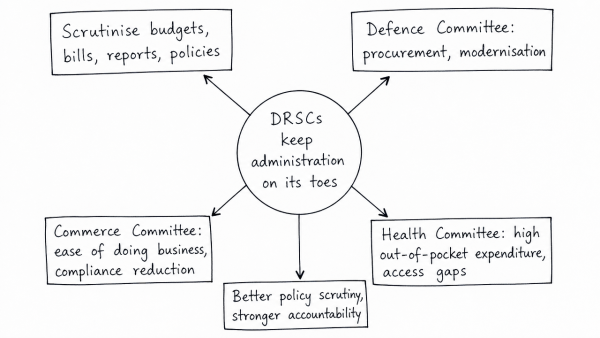
- Keeping the administration alert: They question expenditure, delays and weak outcomes. The Defence Committee, for instance, has scrutinised procurement and technology modernisation, pushing the ministry to justify priorities.
- Better policy scrutiny: The Commerce Committee has examined ease of doing business and compliance reduction, showing how committees can drive reform in depth. The Health Committee has highlighted high private healthcare costs and the need for stronger public health protection.
- Specialised examination: With 24 committees and domain-based membership, they provide detailed scrutiny that the plenary House cannot sustain.
- Limits to parliamentary control: Their recommendations are advisory, not binding. Ministries may accept them partly, and action-taken reports can be delayed or routine.
- Declining referrals: Fewer bills are sent to committees in some Lok Sabhas, weakening their role in law-making.
- Capacity constraints: MPs face time pressure and limited research support, reducing scrutiny of complex areas such as digital regulation and defence technology.
Thus, DRSCs do keep the executive on its toes, but they inspire reverence for parliamentary control only when their reports are regularly referred, seriously debated and faithfully acted upon.
Originally written on
September 2, 2026
and last modified on
September 2, 2026.