Distinguish between religiousness/religiosity and communalism giving one example of how the former has got transformed into the latter in independent India. (UPSC 2017)
Religiousness or religiosity is a personal, inward and spiritual faith. It is expressed through prayer, ritual, moral conduct and devotion, and normally encourages tolerance and peaceful coexistence. Communalism, in contrast, is a political ideology that treats a religious group as a single, hostile political community and pits one community against another.
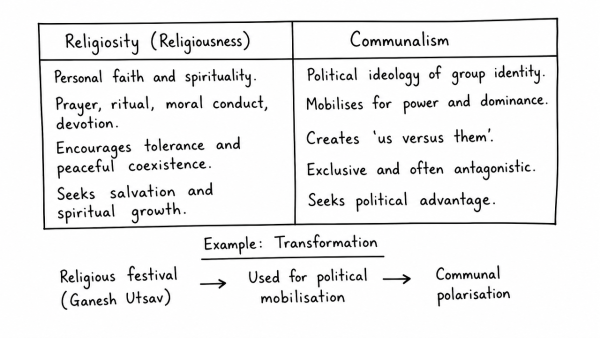
- Religiosity: centred on faith, ethics, worship and spiritual growth.
- Communalism: centred on group identity, power, mobilisation and the idea of “us versus them”.
- Religiosity is inclusive; communalism is exclusive and often antagonistic.
- Religiosity seeks salvation or devotion; communalism seeks political advantage and social dominance.
How transformation happens
- A genuine religious sentiment is converted into a collective political identity.
- Religious symbols are used to claim public space, electoral support or territorial control.
- Differences are exaggerated, and the interests of communities are presented as incompatible.
Example from independent India
The Ram Janmabhoomi movement showed this transformation. Devotion to Lord Ram, which is a matter of personal faith, was turned into a mass political campaign. The religious symbol was used to mobilise people, sharpen Hindu-Muslim polarisation and create an “us versus them” atmosphere, especially during the Babri Masjid-Ram temple conflict.
Thus, religiosity is a matter of faith and worship, while communalism is the misuse of religion for political ends. In a plural society like India, the constitutional ideal is not the removal of faith from life, but its protection from becoming a tool of division.